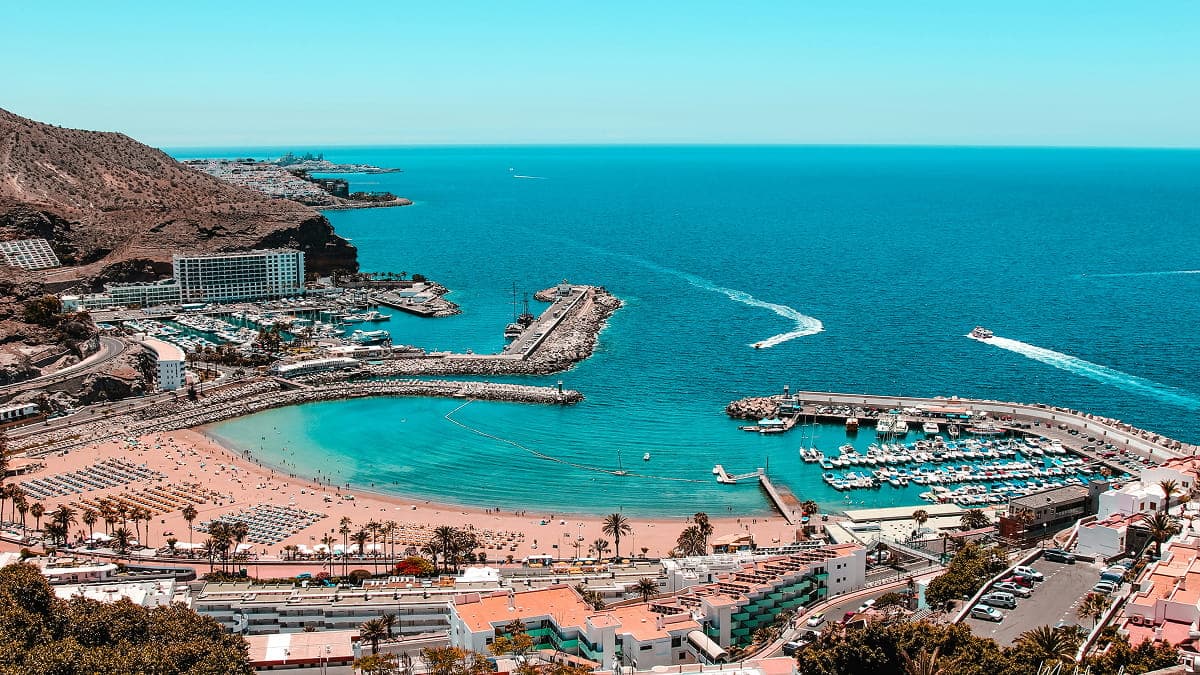
Digital nomad in Gran Canaria? Here's why a permanent move might be better
Gran Canaria is one of Europe's top remote work destinations. But after years of living and building a tech company here, we think the nomad framing misses the point entirely.

Lasting Dynamics team
Editorial team at Lasting Dynamics
Every year, Gran Canaria climbs a little higher on the digital nomad rankings. Nomad List has it in the top 20 globally. Remote work Twitter (or whatever it's called this week) cycles through the same photographs: someone's MacBook on a terrace, a turquoise ocean in the background, a flat white on the table. The caption is always some variation of "office view today 🌊." The likes pour in. And another wave of remote workers books a flight to Las Palmas.
We've watched this happen for years from the inside. Lasting Dynamics has been based in Las Palmas de Gran Canaria long enough to have seen multiple cycles of nomad enthusiasm — the arrivals in October when Northern Europe turns grey, the departures in April when the novelty wears off or the next destination calls. We've had conversations with hundreds of developers who've passed through, and we've hired people who came as nomads and never left. That vantage point gives us something most "best digital nomad destinations" articles don't have: a genuinely long-term perspective.
And our honest take is this: Gran Canaria is a fine nomad destination. But it's an exceptional place to actually live. The difference matters more than most people realise before they arrive.
What the rankings get right
Let's start with what's true, because the hype isn't entirely wrong. The weather is as good as advertised — 22 to 25 degrees Celsius year-round, over 300 days of sunshine, a consistent Atlantic breeze that keeps summers bearable and winters mild. This isn't marketing copy; it's meteorology. For anyone who has spent a winter working from home in Berlin, Amsterdam, or Milan — the psychological weight of grey skies and short days is real, and Las Palmas eliminates it entirely.
The cost of living is genuinely lower than comparable European cities. A one-bedroom apartment in a good neighbourhood of Las Palmas runs between €800 and €1,200 per month on a regular lease — roughly half of what you'd pay in Barcelona for equivalent quality. Restaurants are affordable, public transport is cheap, and the things that make life good (fresh fish, good coffee, proximity to the ocean) cost less than they do in most Western European capitals.
The time zone is also genuinely useful for European remote workers. Gran Canaria runs on UTC/UTC+1 — aligned with Portugal, one hour behind mainland Spain in summer, identical in winter. If your team or clients are in Germany, Italy, the Netherlands, or the UK, you're working essentially the same hours. There's no 3am call, no awkward timezone negotiation, no feeling of being out of sync with the people you work with.
What the rankings get wrong
The nomad framing optimises for the wrong things. When you evaluate a destination as a nomad, you're asking: "Is this a good place to spend two to six months?" That question leads you to weight short-term factors heavily — the vibe of the coworking spaces, the quality of the Airbnbs, the ease of meeting other travellers, the Instagram potential of the scenery.
These are real factors, and Gran Canaria scores reasonably well on most of them. But they're not the factors that determine whether a place is genuinely good for your work and your life over time.
The connectivity situation is a good example. Nomad reviews of Gran Canaria generally report decent internet — and they're right, if you're staying in a well-equipped Airbnb in Las Canteras for a month. But the picture is more complicated than that. Internet quality varies significantly by neighbourhood and by the type of accommodation. Tourist apartments often share bandwidth across multiple units. Some coworking spaces have excellent dedicated connections; others are running on consumer-grade routers that buckle under load. The best coworking spaces in Las Palmas — Coworking Las Palmas on Calle Tomás Miller, The Jungle near Las Canteras beach — have reliable, dedicated connections that can handle real engineering work. But you need to know which ones they are, and you learn that from months of experience, not from a review written after a two-week stay.
The tech ecosystem is another area where expectations often exceed reality. Gran Canaria is not a tech hub. There are no major company offices here, no significant VC presence, no startup accelerators of note. If you're looking for the kind of dense professional networking that happens in Lisbon's LX Factory or Berlin's Mitte, you won't find it in Las Palmas. The tech community is small — a few hundred people at most — and while it's warm and genuine, it's not a substitute for a real startup ecosystem.
The permanent resident advantage
Here's what changes when you stop thinking like a nomad and start thinking like a resident. You sign a proper lease — suddenly you have fibre optic internet that's yours alone, at speeds that make working from home genuinely comfortable. You open a Spanish bank account — suddenly you can set up direct debits, receive salary payments without fees, and stop paying 3% on every transaction. You register on the Padrón (the local census) — suddenly you have access to the Spanish public health system, which is excellent and essentially free at point of use.
These aren't small things. They're the difference between a place that's pleasant to visit and a place that actually works as a base for your professional life. The nomad infrastructure of Gran Canaria — the Airbnbs, the tourist-oriented coworking spaces, the month-to-month flexibility — is designed for people passing through. The resident infrastructure — the rental market, the public services, the local community — is designed for people who stay.
And when you stay, Las Palmas reveals itself differently. The city has a genuine cultural life that's easy to miss if you're only here for a few weeks. The CAAM (Centro Atlántico de Arte Moderno) is a serious contemporary art museum. The Vegueta neighbourhood, the historic old town, has architecture and atmosphere that take months to properly absorb. The local food culture — papas arrugadas, fresh Atlantic fish, mojo sauces — is not a tourist performance, it's a daily reality that becomes part of how you eat and live.
The honest comparison: Gran Canaria vs the alternatives
If you're evaluating Gran Canaria purely as a nomad base against other popular options, here's how we'd frame it honestly. Lisbon is more expensive but has a richer tech ecosystem and better air connections to the rest of Europe. Tbilisi is cheaper and has a buzzing nomad scene, but the timezone is challenging for European clients and the long-term stability is uncertain. Chiang Mai is the classic low-cost option, but the timezone gap with Europe is brutal for anyone working with European teams. Barcelona has everything Gran Canaria has, plus a world-class city — but costs roughly twice as much and has a political environment that some find unsettling.
Gran Canaria sits in an interesting position: it's not the cheapest option, not the best-connected option, not the most exciting city option. But it combines a genuinely liveable climate, reasonable costs, European legal framework, and a quality of daily life that's hard to find elsewhere at the same price point. The ocean is five minutes from most apartments in Las Palmas. The mountains are forty minutes by car. The city is small enough to feel human, large enough to not feel claustrophobic.
Why we're here, and why we're staying
Lasting Dynamics didn't choose Las Palmas because it appeared on a nomad list. We chose it because when we looked at where we wanted to build a team of developers who would work well together over years — not months — this was the answer. The people who join our team and move here tend to stay. Not because they're trapped, but because after a year or two, the calculation becomes obvious: this is a genuinely good place to live and work, and the alternatives mostly offer either more money with worse quality of life, or more excitement with less stability.
If you're a developer considering a move — whether as a nomad testing the waters or as someone thinking about a more permanent change — we're happy to talk through what the experience actually looks like. And if you're interested in joining a team that's already figured out how to make this work, take a look at what we're building and what we offer to people who relocate with us.
The ocean will still be there when you arrive. The question is whether you're coming for a visit or coming to stay.

Lasting Dynamics team
Editorial team at Lasting Dynamics
The Lasting Dynamics team writes from Las Palmas de Gran Canaria, where the company is headquartered.